

- Tawkify Review: Can Matchmaking Get You Off Dating Apps? - October 14, 2026
- The Best Matchmaking Services for Working Professionals - September 28, 2026
- Where to Order Custom Shirts for a Bachelor Party: A Guide for Every Group and Timeline - September 10, 2026
One of my best friends used to squeeze dates into a schedule that already felt impossible. She was in med school, knew she wanted marriage and kids, and sometimes a first date meant going straight from studying or a long day into dinner because there simply wasn’t another free night that week. I watched her try matchmaking services like Three Day Rule because having someone else narrow the field was a lot more realistic than spending hours doing it herself.
What she really needed was help getting to the date. She could find something to wear, take a decent photo, and hold her own once she got there. The exhausting part was everything that came before it: sorting through people, figuring out who might actually want the same things she did, and deciding who was worth giving one of her few free evenings to.

That experience is probably why, if another single friend asked me about Three Day Rule now, I’d start by asking what she actually wanted a matchmaker to take over. Three Day Rule can include quite a bit beyond finding matches, depending on the package: dating strategy, professional photos, styling help, feedback, hold time, and concierge date planning. For someone who wants that whole layer of support, I can see the appeal. For someone more like my friend, I’d want to look harder at what she was getting from the search itself.
That’s where I think some other matchmakers like 3 Day Rule become more interesting. Tawkify is the matchmaking platform I’d most directly compare Three Day Rule to. Its published starting price is a little lower, its published network is much larger, and every proposed match goes through criminal-record and live video screening. But it’s also worth considering local matchmakers, where you’d trade off broader reach for more specialized local knowledge, and whether dating apps still have a part to play.
We’ll compare each of these options, covering network size, feedback loops, screening, success rates, and more, and ultimately decide where each has its place. I think the best fit comes down to what you’re looking for and which parts of dating you’re most tired of doing yourself.
At A Glance
| Service | Public Pricing | Search And Reach | Screening | Date Planning |
|---|---|---|---|---|
| Three Day Rule | Premium memberships start at $6,300 | 250K+ network, nationwide service with a strong presence in 15 major cities | Criminal screening may happen, but it is not promised for every proposed match | Concierge date planning is available; services vary by package |
| Tawkify | Packages start at $4,900 | 3M+ network, with matches across the country and recruiting beyond the existing network | Criminal-record and live video screening for every proposed match | Custom-planned dates are part of the client service |
| Local Matchmaker | Varies | Usually focused on one city or region | Depends on provider | Depends on provider |
| Dating Apps | Free and paid options vary | Typically larger networks (Hinge has 30m US users) but self-directed and dependent on the app and location | Depends on platform. More exclusive apps like Raya reportedly have millions on waitlists | You handle it yourself |
What She’d Be Paying For With Three Day Rule

Three Day Rule gives paying clients a personal matchmaker who gets to know what they are looking for and can search both its network and outside it. The company currently says that network includes more than 250,000 singles. It works nationwide, although its presence is strongest in 15 major cities, which it lists on its website. Checking that against your location is probably a sensible first step.
Depending on the membership, Three Day Rule can include dating strategy sessions, professional photography, styling help, hold time, feedback, and concierge date planning.
I certainly wouldn’t dismiss those things as fluff. If a friend had been married for 15 years and suddenly found herself trying to choose dating photos or wondering what people even wear on first dates now, having somebody help could be a relief. If she felt rusty, overwhelmed, or like she wanted more hand-holding through the whole process, that broader package could be part of why Three Day Rule was worth considering in the first place.
The calculation changes if she already likes her photos, feels comfortable dating, and mostly wants somebody else doing the work of finding people. For my best friend, a photo shoot was never going to create another free Wednesday night. The useful part of matchmaking was getting some of the sorting done before she committed the time to a date.
That’s the distinction I’d want clear before I compared prices. I wouldn’t assume the service with more included is automatically the better value. I’d want the extras to be things I was genuinely relieved to hand over, not things that sounded nice once somebody listed them all out for me.
Who I Think Three Day Rule Makes The Most Sense For

There are people I could pretty easily picture preferring Three Day Rule. Someone coming out of a long relationship would be one. If you haven’t dated in 10 or 15 years, professional photos and some strategy help may not feel like extras at all. You might genuinely want somebody walking you through more of the process instead of just finding a person and sending you to dinner.
I could also see it working well for someone who knows she tends to second-guess herself. Maybe she has plenty of dating experience but keeps choosing the same kind of person, or she wants feedback from somebody who is seeing patterns she isn’t. Having a matchmaker involved beyond the introduction could be useful there.
For me personally, photography and styling would probably fall pretty low on the list of things I’d pay extra for. I’d rather have more of the value concentrated on finding and vetting people. But that’s exactly why I think it helps to figure out what problem you’re actually trying to solve before deciding one package is better than another.
Network Size Sounds Simple Until You Think About Geography

Three Day Rule’s 250,000-plus network is not small, and the company says its matchmakers can recruit outside it. Tawkify publishes a network of more than 3 million and says its matchmakers can recruit beyond that too.
Hinge, one of the most popular dating apps for people seeking a relationship, has over 30 million users, with most of those in the US, though it spans nearly 40 countries.
Local matchmakers will typically have much smaller pools, but if you’re looking to meet someone who lives near you, and if you live in an area with a certain demographic that matches what you’re after as well, more of them are going to be viable matches.
I wouldn’t treat any of those numbers as perfectly comparable statistics because the companies may count their networks differently. And whether it’s 3 million or 30 million, I also wouldn’t assume that anywhere near that many will be realistic options.
Once you add age, location, relationship goals, attraction, lifestyle, whether someone wants kids, and all the things people genuinely aren’t willing to compromise on, every dating pool gets smaller. But while app pools are limited to the users on them, many matchmakers will actively scout for additional options outside of their network.
If I’m in New York, Chicago, or another big dating market, multiple apps and matchmakers may have plenty of people to start. If I live farther outside a major metro, I’d care much more about how actively the matchmaker recruits and what “nationwide” means in practice. Are they finding people near me? Am I expected to drive two hours? Is the assumption that I’m open to relocating?
That matters to me because I live somewhere where driving 40 minutes for something isn’t weird at all, but that doesn’t mean I’d want every first date to turn into a road trip. So I’d look at the network numbers, but I’d ask about the realistic pool after my actual geography is factored in. That tells me more than the headline number by itself. A local matchmaker has a big advantage here in that their pool is naturally going to be centered in my area, and so whatever figure they can share will be closer to the actual number of viable matches.
What Happens After The First Few Matches

This is where I’d want any option I was considering to get specific. What happens once the obvious people have already been considered? Do they actively recruit someone new? Can the geography expand? Does the search change after several dates don’t work? Does the matchmaker go back and reconsider what they learned during intake?
On an app, you might not think to tweak your settings and preferences after each date. And even if you do, you’ve already swiped yes or no on hundreds of people, and you still have thousands to get through. Small adjustments to what you’re looking for get lost in the sheer volume of profiles.
So matchmakers are interesting in that respect, because the feedback loop can create immediate changes, and how they handle feedback matters to me more than simply knowing how many introductions a package includes.
Three Day Rule Alternatives: Pricing

Of course, costs matter too. Three Day Rule starts premium memberships at $6,300, with higher service levels available. Tawkify currently publishes client packages starting at $4,900. Local matchmakers’ pricing varies widely, but you can expect many to be more expensive than larger companies as they don’t have the same economy of scale. But the pricing differences alone wouldn’t decide it for me.
I’d want to know whether the more expensive package was giving me something I would actually use. For one person, professional photography and dating strategy might make Three Day Rule feel like the obvious better value. For someone else, that same money might feel better spent on a service where the biggest selling points are search reach, screening, and the work around the introduction itself.
The apps don’t really fit into this part of the conversation too well. They’re typically free or very inexpensive in comparison, but you are giving up much more time to use them. So they’re solving quite a different problem. That said, there could be occasions where you have the energy to swipe through some profiles and bat away boring opening messages. And it’s far more financially feasible to use an app alongside a matchmaker than to pay for two matchmakers at once.
Looking at the success rates of the various options is interesting, but it’s hard to draw direct comparisons. Three Day Rule reportedly has 84% client satisfaction, but that’s measured as broader contentment with their services, rather than specifically a successful relationship. Tawkify’s reported client satisfaction rate is 92%, and that accompanies an 80% success rate of clients who find success in their initial dozen matches. Local matchmakers often publicize figures in a similar 80-90% success range.
Meanwhile, dating apps tell another story: 72% of Hinge first dates lead to a second date, but only 6% turn into long-term relationships. So you’re playing a different numbers game with them, hoping that quantity eventually leads to quality.
Screening And Photos Pull Me In Opposite Directions
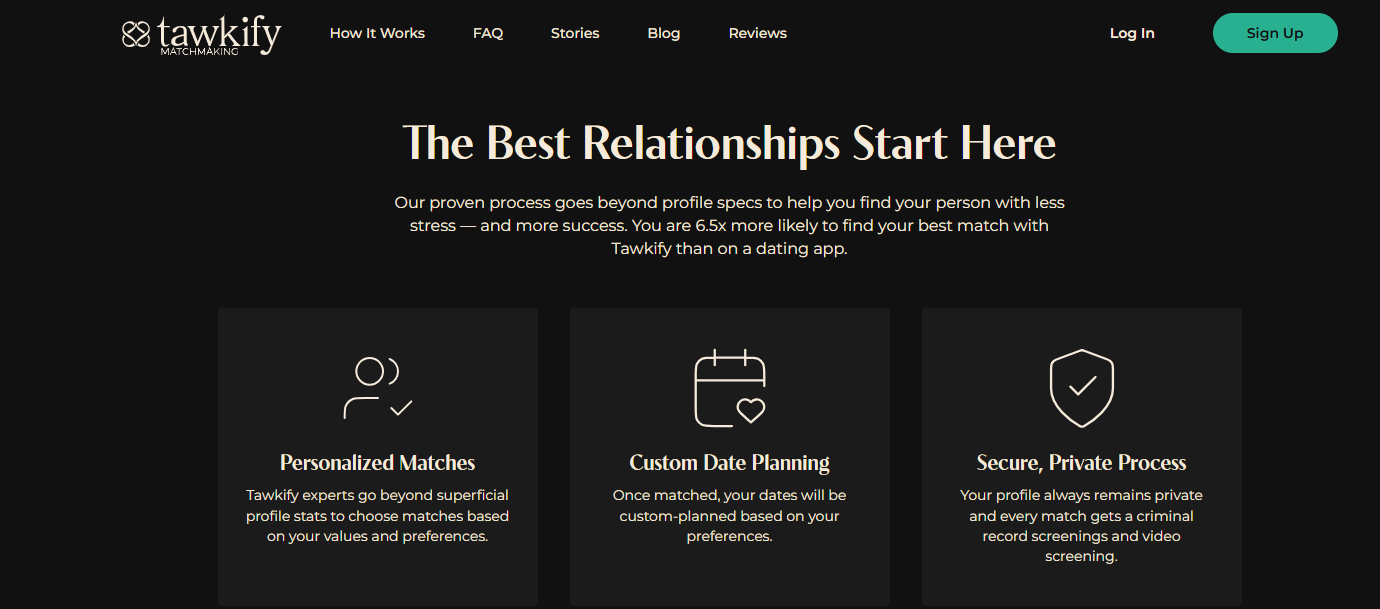
The screening policies of the various matchmakers out there are different enough that I would bring them up early. Three Day Rule says it personally vets potential matches, but its terms do not promise criminal-record screening for every proposed match. Screening may be done in certain situations at the company’s discretion. Tawkify says every proposed match receives both a criminal-record screening and a live video screening. Local matchmakers vary widely here, though some may know their clients well enough personally to be able to vouch for their character.
I’d feel better recommending a process where the same screening step happens every time. A background check cannot tell my friend that someone is kind, honest, emotionally available, or going to be good in a relationship, so I would never treat it like permission to drop normal first-date precautions. I just like knowing exactly what has been checked when someone is paying for professional vetting.
While seeing a photo of a match before a date isn’t the same sort of screening, it does show if you feel that initial superficial attraction to someone. On some apps, swiping left or right based on photos might be the norm and even the extent of the decision. Three Day Rule and Tawkify handle this differently. Three Day Rule shows clients photos of proposed matches before dates. Tawkify intentionally does not exchange photos beforehand, although physical preferences are part of the matching process. Again, local matchmakers vary in their process, so some do also advocate for blind dates.
I understand the argument for Tawkify’s approach. Dating apps make it very easy to stare at someone’s photos, zoom in on details, decide you don’t like one thing, and eliminate a person you might have liked perfectly well across a table.
There is probably something healthy about interrupting that. At the same time, I don’t think wanting to see a photo is automatically shallow or overly picky. Attraction matters. There is also basic comfort in knowing who you’re meeting and who you’re looking for when you walk in somewhere.
If I already knew blind dates made me anxious, I wouldn’t try to talk myself into loving that part of Tawkify just because I preferred other parts of the service. Three Day Rule and other options where you exchange photos would get a real point in their favor there.
What Are You Really Paying To Avoid?
I think this is probably the easiest way I’d narrow things down.
If you hate swiping and sorting through people, most apps like Hinge are out of the question. More exclusive ones like Raya still involve the same photo-based profiles and swiping, but through a much smaller and more curated members list. But matchmakers are the winners here if the priority is getting away from swiping altogether, and in that case, I’d put the most weight on search reach and recruiting.
If you hate wondering whether the person you are meeting is even remotely who they claim to be, screening moves way up the list. Tawkify is strong here, and a local matchmaker who knows their clients better is a good option too.
If you haven’t dated in years and hate the thought of choosing photos, figuring out what to wear, or trying to understand dating now, Three Day Rule’s extra support starts looking much more useful.
If you don’t like the actual planning of first dates, date planning support may matter more to you.
That’s why I don’t think “more services” tells you much by itself. The valuable service is the one taking over the part you’re already sick of doing.
How To Choose the Best Three Day Rule Alternative

First of all, it’s worth reiterating that Three Day Rule has its place. I think the coaching, photography, styling, and broader support can be genuinely useful for somebody who wants that layer of help.
Personally, I’d put more weight on the search itself and on having screening built into every proposed match. I’d rather see more of a matchmaking budget going toward those things. Tawkify is a good alternative here because of the strength of its screening process and the size of its membership.
A local matchmaker could be more interesting than any national name if location is really important. I would care less about how long the matchmaker has been in business than how many people they are actively working with now and whether they recruit when the local pool gets thin. Bear in mind that their pool, while far smaller, may be more qualified.
I would not automatically delete the apps either. They are cheaper and give you control over who you talk to, but they are a lot more work. Hinge has millions of profiles to browse, while exclusive apps like Raya offer a more curated pool that’s harder to access. If you occasionally have the mental capacity to sit down and swipe, you might just get lucky.
If you like choosing your own matches and don’t mind doing the searching, then paying thousands for recruiting, coaching, photos, screening, or date planning may not make much sense. If you want someone taking most of that off your plate, it could.
What to Do Before Signing Anything
A final piece of advice. Before signing anything, I’d want the exact package in writing and a clear picture of what the search looks like in my area. The services you get from Three Day Rule, Tawkify, and any other matchmaker are likely to vary by terms, so I’d want to know which of the things I’m comparing, especially recruiting, screening, coaching, photography, hold time, and date planning, are actually included in the package I’m being quoted. Good luck with your search!